12 free Part 107 practice questions, with answers and sources
The short version
The FAA Part 107 knowledge test has 60 scored questions plus 5 unscored ones, a 2-hour time limit and a 70% passing score, and every question has three answer choices. Below are 12 practice questions in the same three-choice format, each with the answer, the reason and the FAA source behind it. To see where you stand in every test area, take the free Muster Check.
Last reviewed
These are original questions, written from the FAA's published sources: 14 CFR parts 107 and 89, the FAA's advisory circular on small drones, the Remote Pilot Study Guide, the Aviation Weather Handbook, the Aeronautical Information Manual and the Chart User's Guide. They are not actual test questions. Each one was checked against its sources and reviewed before publishing; how we write and check questions.
How to use them
Pick an answer before you open it. The explanation names the rule, and the source line tells you where to read more. The set leans the way the test does: the content weights put 48% on regulations, 25% on operations, 20% on airspace and 5% on weather, so half of these questions are about regulations. Loading and performance (2% of the test) is not in this set. In Pass Muster, a figure cut from a current chart uses a number from 101 up, which the supplement never uses, so the figure in question 7 is not a supplement figure.
The questions
-
Question 1 · Regulations
Which flight of a 3-pound unmanned aircraft is subject to 14 CFR part 107?
Show answer
B. A photographer's flight to take paid photos of a house for sale.
Section 107.1(a) applies part 107 to the operation of civil small unmanned aircraft systems within the United States. A paid aerial-photography flight with an aircraft weighing less than 55 pounds is such an operation and falls under none of the exclusions in section 107.1(b), so part 107 governs it.
Source
- 14 CFR Part 107 (eCFR), 107.1, 107.3
- AC 107-2A Small Unmanned Aircraft System (Small UAS), 4.1
-
Question 2 · Regulations
The minimum flight visibility of 3 statute miles for a small UAS operation is measured as observed from:
Show answer
C. the location of the control station.
Section 107.51(c) states that the minimum flight visibility, as observed from the location of the control station, must be no less than 3 statute miles.
Source
- 14 CFR Part 107 (eCFR), 107.51
- AC 107-2A Small Unmanned Aircraft System (Small UAS), 5.12
-
Question 3 · Airspace classification and operating requirements
What does the Low Altitude Authorization and Notification Capability (LAANC) provide to a part 107 remote pilot?
Show answer
C. Near real-time airspace authorization within UAS Facility Map altitudes.
The AIM states that LAANC gives the remote pilot the ability to obtain near real-time airspace authorization within UASFM altitudes, the maximum altitudes at which an operation can be approved without further coordination with ATC.
Source
- Aeronautical Information Manual (HTML), 11-4-2, 11-1-2
- 14 CFR Part 107 (eCFR), 107.45
-
Question 4 · Regulations
Must a visual observer (VO) hold an airman medical certificate to take part in a part 107 operation?
Show answer
C. No; but a known condition that could interfere with safe operation bars them.
AC 107-2A paragraph 5.6 states that although the VO is not required to obtain an airman medical certificate, the VO cannot participate in the operation if he or she knows or has reason to know of a physical or mental condition that could interfere with the safe operation of the small UAS (section 107.17).
Source
- AC 107-2A Small Unmanned Aircraft System (Small UAS), 5.6
- 14 CFR Part 107 (eCFR), 107.17
-
Question 5 · Operations
According to 14 CFR part 107, which facilities are covered by the prohibition on interfering with operations and traffic patterns?
Show answer
A. Airports, heliports, and seaplane bases.
Section 107.43 states that no person may operate a small unmanned aircraft in a manner that interferes with operations and traffic patterns at any airport, heliport, or seaplane base; AC 107-2A repeats that the prohibition covers airports, heliports, and seaplane bases.
Source
- 14 CFR Part 107 (eCFR), 107.43
- AC 107-2A Small Unmanned Aircraft System (Small UAS), 5.10
-
Question 6 · Regulations
According to 14 CFR part 107, a temporary remote pilot certificate with a small UAS rating is issued for up to:
Show answer
A. 120 calendar days.
Section 107.64(a) states that a temporary remote pilot certificate with a small UAS rating is issued for up to 120 calendar days, at which time a permanent certificate will be issued to a person whom the Administrator finds qualified.
Source
- 14 CFR Part 107 (eCFR), 107.64, 107.65
-
Question 7 · Airspace classification and operating requirements
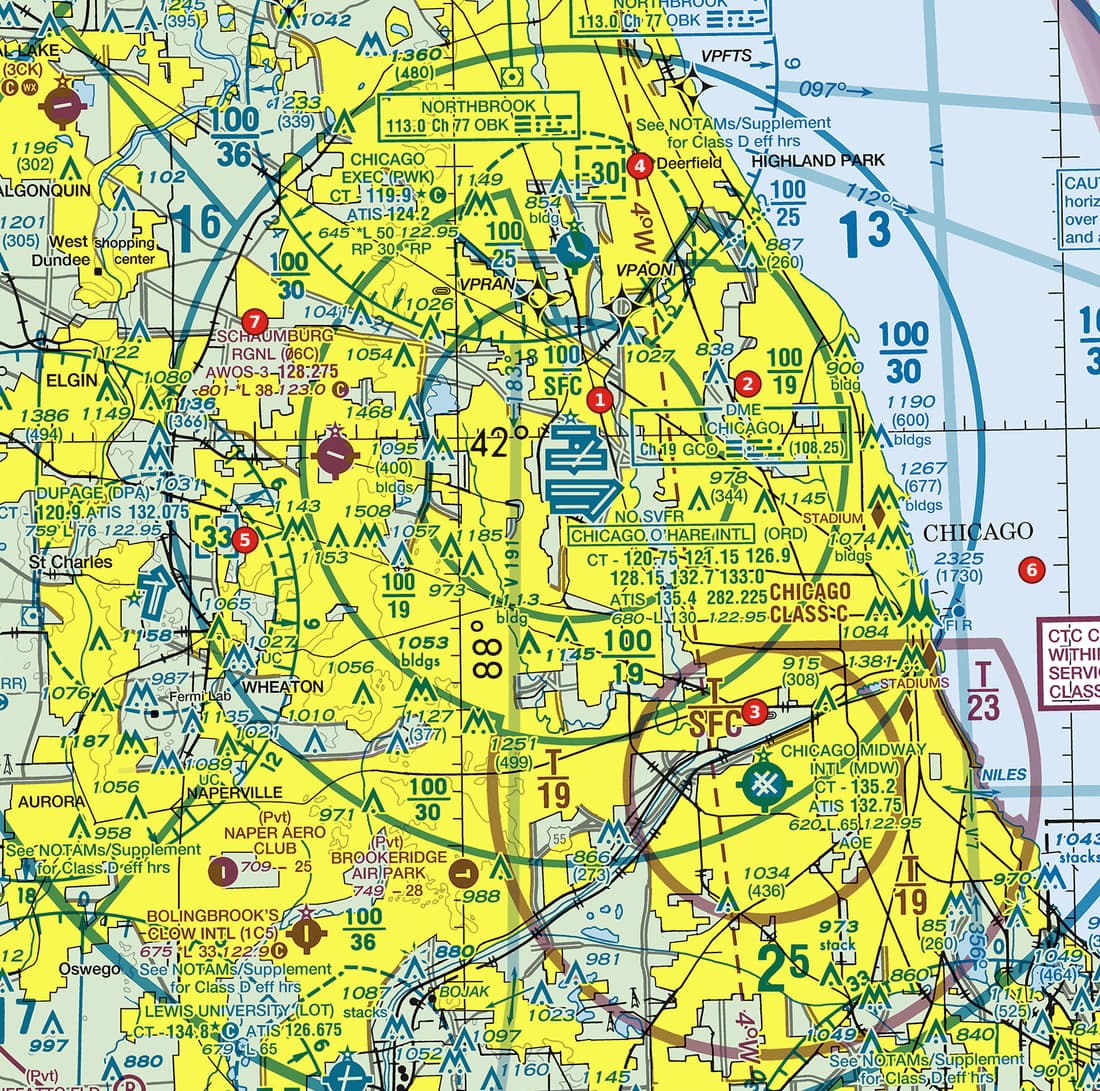 Open Figure 104, area 7 full size
Figure 104, area 7 Lakeside metropolitan Class B with two major airports, sector blocks, a Class C core and satellite Class D airports. Tap to zoom. (Refer to Figure 104, area 7.) About how far above the airport at area 7 does the Class B airspace begin?
Show answer
C. About 2,200 feet
The block reads 100 over 30, so Class B begins at 3,000 feet MSL; the data block gives the airport elevation as 801 feet MSL, so the floor is about 2,200 feet above the field.
Source
- Aeronautical Chart User's Guide, p. 16, p. 15
2 sections
vfr terms p16; vfr terms p15 - Remote Pilot Study Guide (FAA-G-8082-22), ch. 2
1 section
controlled airspace class b airspace
- Aeronautical Chart User's Guide, p. 16, p. 15
-
Question 8 · Weather
Which factor has the greatest effect on density altitude?
Show answer
C. Temperature.
The weather handbook says temperature is the most important factor in density altitude, since temperature has the greatest effect on density horizontally in the atmosphere: hot days give high density altitudes and cold days low ones.
Source
- Aviation Weather Handbook (FAA-H-8083-28B), 8.4.1.5
-
Question 9 · Regulations
A remote pilot will fly an aircraft without remote identification equipment at an FAA-recognized identification area (FRIA). Under 14 CFR part 89, where must the pilot be throughout the flight?
Show answer
C. Within the area's boundaries, like the aircraft.
Section 89.115(b)(1) states that the unmanned aircraft and the person manipulating the flight controls of the unmanned aircraft system must remain within the boundaries of an FAA-recognized identification area throughout the operation, and AC 107-2A paragraph 5.17.3.2 confirms this route applies to part 107 operations.
Source
- 14 CFR Part 89 (eCFR) — Remote Identification of Unmanned Aircraft, 89.115
- AC 107-2A Small Unmanned Aircraft System (Small UAS), 5.17
-
Question 10 · Operations
In the IMSAFE personal checklist, what does the letter S stand for?
Show answer
B. Stress.
The study guide gives IMSAFE as Illness, Medication, Stress, Alcohol, Fatigue, and Emotion; the AIM's personal checklist lists the same six categories of impairment.
Source
- Remote Pilot Study Guide (FAA-G-8082-22), ch. 9
1 section
physiological medical factors that affect pilot performance drugs - Aeronautical Information Manual (HTML), 8-1-1
- Remote Pilot Study Guide (FAA-G-8082-22), ch. 9
-
Question 11 · Regulations
Outside any closed- or restricted-access site, a remote pilot plans to hover over traffic on a public road. Which category of operation can permit this?
Show answer
B. Category 4
Section 107.145(c) sets no sustained-flight limit for Category 4; the aircraft must hold an airworthiness certificate under part 21 and be operated within Flight Manual limitations that do not prohibit operations over human beings in moving vehicles. AC 107-2A paragraph 8.3.3 notes Category 4 aircraft may be eligible to operate over moving vehicles when those limitations do not prohibit it.
Source
- 14 CFR Part 107 (eCFR), 107.145
- AC 107-2A Small Unmanned Aircraft System (Small UAS), 8.3
-
Question 12 · Operations
For the purpose of deviating from a part 107 rule, an in-flight emergency is:
Show answer
A. an unexpected, serious situation needing urgent action.
AC 107-2A, paragraph 5.18, defines an in-flight emergency as an unexpected and unforeseen serious occurrence or situation that requires urgent, prompt action; in that case section 107.21 permits the remote pilot in command to deviate from any rule of part 107 to the extent necessary to meet the emergency.
Source
- AC 107-2A Small Unmanned Aircraft System (Small UAS), 5.18
- 14 CFR Part 107 (eCFR), 107.21
How the real test differs
- Length. The real test is 65 questions: 60 count toward your score and 5 are unscored questions the FAA uses for validation. You need 70% of the scored ones (FAA Airman Knowledge Testing Matrix; 14 CFR 107.67(c)).
- Time. You have 120 minutes for all of it, so pace matters more than on a page you can scroll at leisure.
- Figures. A question that uses a figure shows it on screen, next to the question. Since October 26, 2026, the FAA says the test can include image-based questions not found in the printed testing supplement, such as current sectional chart excerpts (what changed). Practice reading charts you have not seen: chart practice and the sectional chart notation decoder.
- Coverage. The test covers all five areas, with the weights above, and its knowledge comes from the FAA's UAS Airman Certification Standards. 12 questions cannot tell you how ready you are in each area.
Next: the free Muster Check
25 questions across all five test areas, weighted like the real test, about 15 minutes, no signup. You get a score for each area and the source behind every answer, so you know what to study first.
Take the free Muster CheckFigure: FAA VFR sectional chart excerpt (public domain), markers added. Independent study tool. Not affiliated with or endorsed by the FAA.