Load factor and stall speed in a turn
Bank a fixed-wing aircraft in a level turn and its wing must lift more than its weight. Step through the bank angles on the FAA's load factor chart and watch the load and the stall speed climb, then drill on the kinds of chart questions the test asks.
Last reviewed
Calculator
Result
-
Load factor
1.154 G
Read off the chart's 30° row.
Source: Remote Pilot Study Guide, chapter 4: Load Factors
-
Total load on the structure
11.5 lb
10 lb × 1.154. A load factor of 3 means the total load is three times the weight.
Source: Remote Pilot Study Guide, chapter 4: Load Factors
-
Stall speed
32 kt
30 kt × √1.154 (1.07). Stall speed rises with the square root of the load factor.
Source: Remote Pilot Study Guide, chapter 4: Load Factors and Stalling Speeds
Stall speed applies to fixed-wing aircraft. The chart is for a coordinated, constant-altitude turn.
Drill: chart, load and stall speed
Aircraft, weights and speeds are generated for practice; the load factors are the chart's.
What to know for the test
- Load factor is total load over weight, in G: a load factor of 3 means the structure carries three times the aircraft's weight.
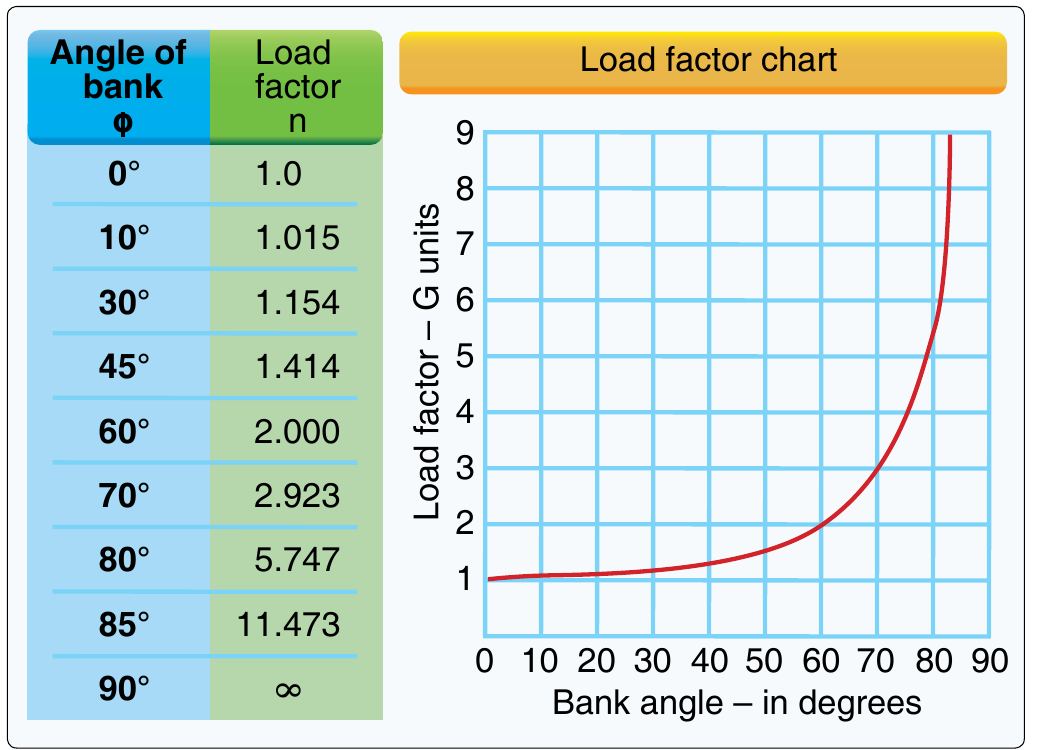
- In a level turn it depends only on bank angle. At 60° it is 2 G; it rises at a terrific rate past 45° to 50°, and a level 90° turn is impossible.
- Stall speed rises with the square root of the load factor. 50 kt unaccelerated becomes 100 kt at 4 G and 150 kt at 9 G.
- Steep turns and quick pull-ups raise the load factor, and so the stall speed: an aircraft can stall at a seemingly safe speed, and a sudden loss of control in a steep turn near the ground has caused many accidents.
- Extra weight raises stall speed too: an overloaded aircraft has a higher stalling speed, a longer takeoff run and a reduced rate of climb. So does ice on the wing.
Sources: Remote Pilot Study Guide, chapter 4: Load Factors; Remote Pilot Study Guide, chapter 4: Load Factors in Steep Turns; Remote Pilot Study Guide, chapter 4: Load Factors and Stalling Speeds; Remote Pilot Study Guide, chapter 4: Effects of Weight; Aeronautical Information Manual 7-1-19 (effects of ice).
The load factor chart, row by row
The FAA's load factor chart lists these bank angles. The last column is how much the stall speed is multiplied by (the square root of the load factor).
| Bank angle | Load factor | 10 lb aircraft carries | Stall speed × |
|---|---|---|---|
| 0° | 1 G | 10.0 lb | 1.00 |
| 10° | 1.015 G | 10.1 lb | 1.01 |
| 30° | 1.154 G | 11.5 lb | 1.07 |
| 45° | 1.414 G | 14.1 lb | 1.19 |
| 60° | 2 G | 20.0 lb | 1.41 |
| 70° | 2.923 G | 29.2 lb | 1.71 |
| 80° | 5.747 G | 57.5 lb | 2.40 |
| 85° | 11.473 G | 114.7 lb | 3.39 |
| 90° | ∞ G | — | — |
Load factor chart (FAA knowledge test supplement, Figure 2): the calculator above shows the figure itself, with the row you pick marked. On the graph, the curve is the same rows drawn as a line.
Find your own gaps first
Loading and performance is one area of five. The free Muster Check covers all of them in the proportions the real test uses, scores each one, and shows the explanation and cited source for every question.
Sources
- Remote Pilot Study Guide (FAA-G-8082-22), chapter 4: Load Factors, Load Factors in Steep Turns, Load Factors and Stalling Speeds, and Effects of Weight.
- Airman Knowledge Testing Supplement (FAA-CT-8080-2H), Figure 2, Load Factor Chart: the bank angles and load factors in the table and the slider.
- Aeronautical Information Manual 7-1-19: ice increases stall speed.
- UAS Airman Certification Standards (FAA-S-ACS-10B): Area IV Loading and Performance, Task A, code UA.IV.A.K1a.
Independent study tool. Not affiliated with or endorsed by the FAA. The FAA is named above as the publisher of public-domain documents, not as an endorser. This is a study aid, not your aircraft's limits: use the manufacturer's data.